




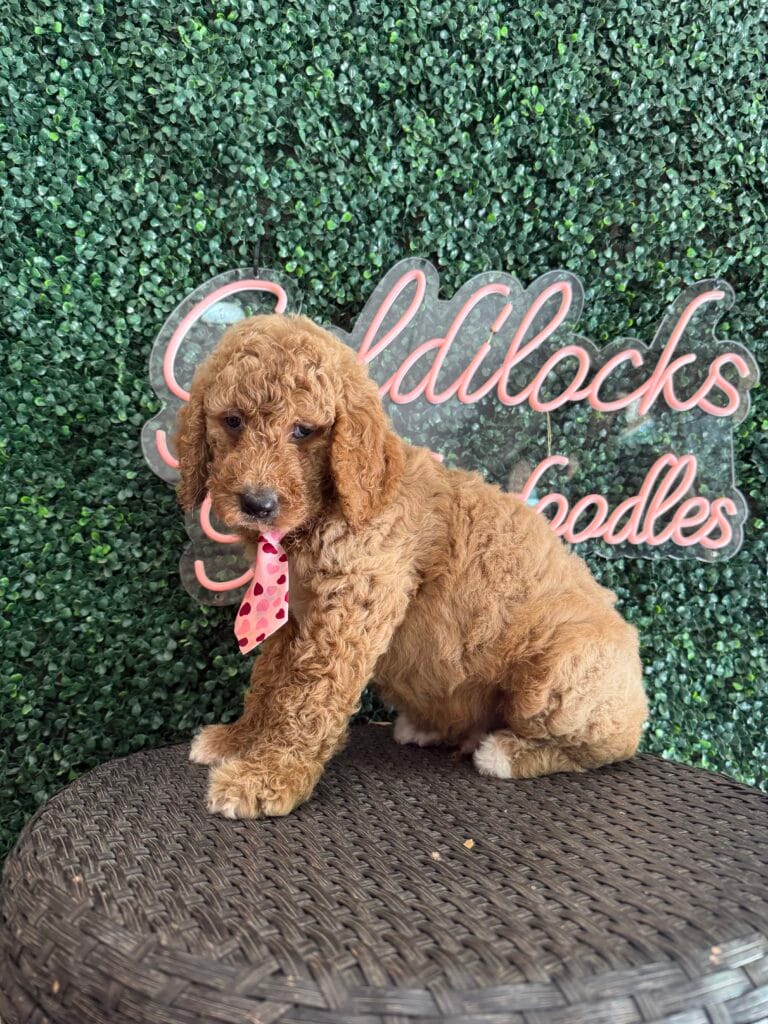
If you’ve spent any time researching Goldendoodle sizes online, you’ve probably walked away more confused than when you started. One website says a Mini tops out at 20 pounds. Another says 40. Someone on Reddit swears their “Mini” hit 55. Nobody seems to agree — and when you’re about to spend $2,500 to $3,500 on a puppy who’ll live with your family for the next 12 to 15 years, that confusion is genuinely stressful.
This guide exists because “how big will my Goldendoodle get?” is the single most important question we field — and the one with the most misleading answers online. We breed Micro, Mini, Medium, and Standard Goldendoodles here in Dallas, Texas, and after 12+ years we’ve tracked the growth of more puppies than most breeders will ever produce. This guide pulls all of that into one place: honest weight ranges by age, the formulas we use to predict adult size, and a weight calculator you can use on your own puppy right now.
One thing we always tell families upfront: no breeder can guarantee an exact adult size. Goldendoodles are hybrid dogs, and genetics don’t follow a formula. What we can do is give you the most accurate ranges based on parent weights, generations, and the hundreds of puppies we’ve placed over the years.
Goldendoodle sizes at a glance
We breed four sizes at Goldilocks Goldendoodles, each defined primarily by the size of the Poodle parent used in breeding:
| Size | Adult weight | Adult height | Poodle parent | Finishes growing |
|---|---|---|---|---|
| Micro | 15–20 lbs | 10–14 inches | Toy Poodle | 7–11 months |
| Mini | 25–35 lbs | 13–17 inches | Miniature Poodle | 11–13 months |
| Medium | 35–50 lbs | 17–21 inches | Moyen/Standard Poodle | 12–15 months |
| Standard | 50–65 lbs | 20–24 inches | Standard Poodle | 12–16 months |
Males in every size category typically run 10–15% heavier than females. F1B Goldendoodles (75% Poodle) tend to be slightly lighter than F1s of the same size label, since the Poodle influence is stronger.
Weight charts by size — from 8 weeks to fully grown
Select your puppy’s size to see the full weight-by-age chart. These ranges are based on our breeding records and are consistent with data from thousands of Goldendoodle owners across the US. Treat them as healthy reference ranges, not guarantees.
15–20 lbs
Adult weight
10–14 in
Adult height
7–11 mo
Fully grown
The Micro is the smallest size we breed — a Toy Poodle crossed with an F1 Goldendoodle. Perfect for apartment living, travel, and families who want all the Goldendoodle personality in a compact package.
| Age | Female weight | Male weight | Milestone |
|---|---|---|---|
| 8 weeks | 1.5–3 lbs | 2–3.5 lbs | Pickup age |
| 10 weeks | 2–4 lbs | 2.5–4.5 lbs | |
| 3 months | 3–6 lbs | 4–7 lbs | |
| 4 months | 5–8 lbs | 6–9 lbs | ~50% adult weight |
| 5 months | 7–10 lbs | 8–11 lbs | |
| 6 months | 9–13 lbs | 10–14 lbs | ~75% adult weight |
| 8 months | 12–16 lbs | 13–18 lbs | |
| 10 months | 13–18 lbs | 14–19 lbs | |
| 12 months+ | 14–19 lbs | 15–20 lbs | Fully grown |
Breeder tip
For a Micro, multiply your puppy's 8-week weight by 4.3 to get a rough adult weight estimate. So a 2.5 lb puppy at 8 weeks will likely mature around 10–11 lbs. Keep in mind this formula works best between 8–12 weeks.
25–35 lbs
Adult weight
14–17 in
Adult height
11–13 mo
Fully grown
Our most popular size. The Mini hits the sweet spot — small enough for most homes and apartments, big enough to keep up on hikes and play sessions. A Miniature Poodle is used as the Poodle parent.
| Age | Female weight | Male weight | Milestone |
|---|---|---|---|
| 8 weeks | 4–7 lbs | 5–8 lbs | Pickup age |
| 10 weeks | 5–9 lbs | 6–10 lbs | |
| 3 months | 8–13 lbs | 9–14 lbs | |
| 4 months | 11–16 lbs | 12–18 lbs | ~50% adult weight |
| 5 months | 14–20 lbs | 15–22 lbs | |
| 6 months | 17–24 lbs | 18–26 lbs | ~70% adult weight |
| 8 months | 20–28 lbs | 22–30 lbs | |
| 10 months | 22–31 lbs | 24–33 lbs | |
| 12 months+ | 24–32 lbs | 26–35 lbs | Fully grown |
Breeder tip
For a Mini, double your puppy's weight at 14–16 weeks for a reasonable adult estimate. A 10 lb puppy at 4 months will likely mature around 18–22 lbs. Weight stabilises fastest in this size — most Minis are done growing by 11 months.
35–50 lbs
Adult weight
17–21 in
Adult height
12–15 mo
Fully grown
The Medium is the perfect active family dog — substantial enough to rough-and-tumble with older kids but doesn’t require a huge home. Uses a Moyen or smaller Standard Poodle parent.
| Age | Female weight | Male weight | Milestone |
|---|---|---|---|
| 8 weeks | 7–11 lbs | 8–13 lbs | Pickup age |
| 10 weeks | 9–14 lbs | 10–15 lbs | |
| 3 months | 13–20 lbs | 15–22 lbs | |
| 4 months | 18–26 lbs | 20–28 lbs | ~50% adult weight |
| 5 months | 22–32 lbs | 24–34 lbs | |
| 6 months | 26–37 lbs | 28–40 lbs | ~70–75% adult weight |
| 8 months | 30–43 lbs | 33–46 lbs | |
| 10 months | 33–46 lbs | 35–48 lbs | |
| 12–15 months | 35–47 lbs | 38–50 lbs | Fully grown |
Breeder tip
For a Medium, use the 6-month weight and divide by 0.75 to estimate adult weight. A 30 lb pup at 6 months will likely finish around 38–42 lbs. Medium Goldendoodles take a couple of extra months vs. Minis to fully fill out their chest and shoulders.
50–65 lbs
Adult weight
20–24 in
Adult height
12–16 mo
Fully grown
The Standard is all Golden Retriever heart in an athletic frame. These are big, joyful, active dogs that need space and daily exercise. The Poodle parent is a full Standard Poodle.
| Age | Female weight | Male weight | Milestone |
|---|---|---|---|
| 8 weeks | 9–14 lbs | 11–16 lbs | Pickup age |
| 10 weeks | 12–18 lbs | 14–20 lbs | |
| 3 months | 18–27 lbs | 20–30 lbs | |
| 4 months | 24–36 lbs | 27–40 lbs | ~50% adult weight |
| 5 months | 30–44 lbs | 33–48 lbs | |
| 6 months | 34–49 lbs | 38–54 lbs | ~65–70% adult weight |
| 8 months | 40–55 lbs | 44–60 lbs | |
| 10 months | 44–58 lbs | 48–63 lbs | |
| 12–16 months | 46–60 lbs | 50–65 lbs | Fully grown |
Breeder tip
For a Standard, multiply your puppy's 4-month weight by 2 and add 5–10 lbs. A 28 lb puppy at 4 months will likely finish between 61–66 lbs. Standards are the slowest to mature — many don't fully fill out until 14–16 months, and some continue adding muscle mass into month 18.
The quick adult weight calculator — 3 formulas that actually work
No formula is perfect, but these three give you a solid ballpark when your puppy is still young. Use the one that matches your puppy’s current age most closely:
Estimates are based on observed growth patterns across hundreds of Goldendoodle puppies. Individual results vary based on genetics, diet, and generation. Parent weights from your breeder are the most reliable size predictor. Always consult your veterinarian for personalised guidance.
Important
These formulas work best between 8–16 weeks. The older your puppy, the more accurate the estimate. And always remember: parent weights from your breeder are the single most reliable predictor of adult size — ask us and we'll walk you through what the parents weighed.
What actually determines how big your Goldendoodle will get?
We’re asked this constantly, and the honest answer is: it’s mostly genetics, with a few lifestyle factors that influence the upper and lower end of the range.
1. Parent size and generation
The Poodle parent is the single biggest size lever in Goldendoodle breeding. A Toy Poodle produces a Micro; a Standard Poodle produces a Standard. But within a generation, there’s natural variation. Two F1B Minis from the same parents can vary by 5–7 lbs at adult weight — that’s completely normal and not a sign anything went wrong.
Generation also plays a role. F1B Goldendoodles (75% Poodle) tend to be slightly lighter and more refined in build than F1s of the same size label, because the Poodle influence is stronger. F2s can vary more than either, since you’re combining two hybrid dogs.
2. Gender
Males typically weigh 10–15% more than females in the same size category. In practical terms, that means a male Mini might top out at 33–35 lbs while his female littermate finishes at 26–28 lbs. If you’re choosing between male and female and size matters to you, this is worth factoring in.
3. Spay and neuter timing
Dogs spayed or neutered before growth plates close (typically around 12 months) often grow slightly taller and rangier than intact dogs, because the absence of sex hormones allows the growth plates to stay open longer. This doesn’t mean they get heavier — just slightly leggier in some cases. We recommend discussing timing with your vet, and most of our families wait until at least 9–12 months for this reason.
4. Nutrition and exercise
Overfeeding a puppy doesn’t make them grow bigger — it makes them gain fat, which stresses their developing joints and can cause lasting orthopaedic problems. A puppy growing within its natural genetic range on a balanced diet will reach the top of that range; one who’s overfed may exceed it with excess body fat rather than healthy muscle. Feed measured meals, not free choice, and work with your vet on portion sizes.
Growth stages: what to expect at each phase
The rapid phase: 8 weeks to 6 months
This is when growth is most dramatic. Your puppy may seem to change almost daily. Most Goldendoodles reach 50–70% of their adult weight during this phase. Energy is high, sleep needs are high, and appetite is voracious. Don’t be alarmed by the pace — it’s normal. What matters is that growth is steady, not that it matches a chart exactly.
Watch for this
Over-exercising during this phase can damage growth plates permanently. Follow the 5-minute rule: no more than 5 minutes of structured exercise per month of age, twice daily. A 4-month-old gets two 20-minute sessions max — not a 2-mile run.
The slowdown phase: 6–12 months
Growth continues but becomes less dramatic week-to-week. Your puppy reaches their full height during this period but looks gangly and unfinished — this is normal and sometimes called the “teenage lanky phase.” They fill out in chest depth, muscle mass, and coat thickness over the months that follow.
The finishing phase: 12–18 months
Minis and Micros are typically done by 12–13 months. Standards and larger Mediums continue filling out until 14–16 months, sometimes 18. You may notice your dog’s chest drop and deepen, their shoulders and hindquarters fill out, and their coat reach full adult texture and volume. The weight gain during this phase is modest — usually 2–5 lbs — but the visual change can be striking.
When to call your vet about your puppy's growth
These charts are guides, not rules. But certain patterns are worth a conversation with your veterinarian:
- Your puppy is consistently below the low end of the weight range and losing energy or appetite
- Your puppy is growing significantly faster than the high end and appears bloated or pot-bellied
- Your puppy’s weight has plateaued completely before 6 months of age
- You notice limping, reluctance to bear weight, or difficulty going up stairs (possible early joint issue)
- Dramatic weight loss over 1–2 weeks without a dietary change
Routine vet check-ups at 8, 12, and 16 weeks are the best early warning system. Your vet will plot your puppy’s growth on a standardised chart and flag anything that doesn’t look right well before it becomes a problem.
A note from us: what the weight chart can't tell you
We’ve placed hundreds of Goldendoodle puppies with families across Texas and the US, and the one thing we’ve learned is that the number on the scale is only part of the story. A 28 lb Mini with a healthy coat, clear eyes, strong energy, and a happy appetite is thriving — whether or not she exactly matches a chart.
What we track far more closely than raw weight is body condition — whether you can feel (but not see) your dog’s ribs, whether they have a visible waist tuck from above, and whether their energy and appetite are consistent. That’s the real measure of a healthy, well-grown Goldendoodle.
When you bring home a puppy from us, we share the parent weights with you, give you a health folder with your puppy’s weight history from birth, and are available by phone or text for the lifetime of your dog — not just pickup day. If you ever have growth questions, we want to hear them.
Frequently asked questions about Goldendoodle growth and weight
At what age is a Goldendoodle fully grown?
It depends on size. Micro Goldendoodles are typically done growing by 7–11 months. Minis finish around 11–13 months. Mediums take 12–15 months, and Standards can grow until 14–16 months. All sizes may continue to add muscle mass and chest depth for a few months beyond when their weight stabilises.
How much should a Goldendoodle puppy weigh at 8 weeks?
It varies significantly by size. Micro puppies at 8 weeks typically weigh 1.5–3.5 lbs. Mini puppies weigh 4–8 lbs. Medium puppies weigh 7–13 lbs. Standard puppies weigh 9–16 lbs. The 8-week weight is one of the earliest indicators of adult size, though it’s not definitive on its own.
Can I predict my Goldendoodle's adult size from their paw size?
Not reliably. Large paws relative to body size are common in puppies of all breeds, and they don’t consistently predict adult size. Parent weights and the puppy’s own weight trajectory are much more accurate indicators. Ask your breeder for the parent weights — that’s the best starting point.
Will my Goldendoodle get bigger if I feed them more?
No — overfeeding a puppy causes fat gain, not height or frame growth, which is determined by genetics. Excess weight during puppyhood puts unnecessary stress on developing joints and is one of the most common causes of early-onset hip and elbow problems in the breed. Feed measured, age-appropriate portions and let genetics do the rest.
My puppy weighs more than the chart shows. Should I be worried?
Not necessarily. These are reference ranges, not strict rules. If your puppy is active, eating well, and your vet is happy with their body condition score, a few pounds above the range is usually fine — especially for males, who often run heavier. If you’re consistently well above the range and your vet has concerns, a diet review is worth doing.
Does spaying or neutering affect how big my Goldendoodle gets?
Timing can have a modest effect. Dogs altered before their growth plates close (typically around 12 months) may grow slightly taller, as sex hormones play a role in plate closure. This is more noticeable in Standards than in Micros or Minis. Most vets and breeders recommend waiting until at least 9–12 months before spaying or neutering for this reason.
Wondering which size is right for your family?
We breed all four sizes — Micro, Mini, Medium, and Standard — and we love helping families find their perfect match. Browse our available puppies or get in touch and we'll walk you through the options.
Share the Post: